Architecting the Laundry Revenue Ladder: The Math Behind the Utility Mindset
Technical Briefing: Engineering Machine Velocity and the Labor Loop
Welcome to another Technical Briefing from The Lab at AIforLaundromats.org. Inside our Living Lab at Super Kleen Laundry, we continuously dissect the friction points that prevent a commercial vended laundry facility from operating as a highly optimized, automated processing plant. In this briefing, we are isolating two of the most critical structural components of Precision Laundry Architecture: Engineering Machine Velocity through the Wash/Dry/Go strategy, and triggering passive sales through the Labor Loop.
If you want to pull yourself out of the weeds and step into the control tower of your business, the physical floor of your facility must run flawlessly without your constant intervention. The following blueprint details exactly how we bypass physical labor bottlenecks, protect our capital expenditure, and architect a psychological pricing model that creates supreme volume.
The Trap of the Boutique Fold
To understand how to engineer maximum throughput, you must first understand the primary flaw of the traditional drop-off laundry model. Traditional wash/dry/fold is essentially a boutique service. While it looks great on paper due to its high profit margins, it relies on a highly customized, incredibly labor-heavy process.
The physical act of folding creates an immense operational bottleneck on your floor. You can only fold a shirt with origami-level precision so fast. When your attendants are trapped at folding tables meticulously creasing garments for 45 minutes per order, they are ignoring the rest of the facility. As volume scales, this physical folding stage chokes your operational capacity and forces you to constantly hire more labor just to keep up with the pile of clean clothes waiting to be processed.
To eliminate this friction and unlock true capacity, we engineered a complete disruption of the standard setup: the Wash/Dry/Go strategy.
Wash/Dry/Go and Categorized Stacking
The Wash/Dry/Go strategy shifts the facility from a boutique, high-labor shop to a high-volume, low-friction processing model. It completely bypasses the labor-intensive folding stage without sacrificing the professional presentation that customers expect.
To accomplish this, our attendants utilize a technique called "Categorized Stacking". Instead of spending 45 minutes on origami-level creasing for a family's laundry, the attendant focuses on building a foundation. They lay a flat, sturdy base using the heaviest items in the order, such as jeans or thick towels. Once the heavy base is established, they cascade the lighter items—like shirts and pants—perfectly flat on top of one another. The entire stack is then vacuum-sealed into a crisp, clear, professional bag.
This method maintains a highly professional presentation, but the operational gain is staggering: it reduces the physical touch time of an order from 45 minutes down to just 4 minutes. This is a massive reduction in labor cost and immediately clears the bottleneck on your processing tables.
The Math of the Utility Mindset
If you are saving immense labor time by skipping the premium fold, you have to ensure the sheer volume of orders makes up for the lack of a high boutique fee. This requires a highly strategic approach to pricing that shifts the customer's perception of your service.
In our rural market of Lake City, which has a population of around 5,000 people, we anchor the Wash/Dry/Go price at an aggressively competitive 75¢ per pound. The psychological goal behind this price point is to create a "utility" mindset rather than a "luxury" mindset. We want the customer to view our drop-off laundry service the exact same way they view paying their basic water or electricity bill—an affordable, absolutely essential utility that they do not have to think twice about utilizing.
However, offering a service at just 75¢ per pound introduces a risk to your profit margins if customers only drop off a few items at a time. To absolutely protect the profit margin, the Wash/Dry/Go strategy enforces a strict 26 lb minimum on every order.
This 26 lb minimum is the absolute lynchpin of the entire architecture. By enforcing this rule, you mathematically guarantee a floor revenue of $19.50 for every single transaction. This ensures that every single time an attendant touches a bag, their brief 4-minute touch time is entirely financially justified by the system. You are no longer losing money on labor for small, inefficient loads.
Furthermore, this pricing logic scales beautifully across different geographic demographics. While we utilize the 75¢ per pound target for rural dominance, suburban markets can easily scale this exact same model to $1.25 per pound, and urban or metro markets can hit $1.75 per pound. Regardless of the market, the logic of the minimum touch-time value remains perfectly constant.
The Pocket Audit: A Self-Funded Maintenance Plan
When you increase the sheer volume of laundry moving through your facility, you also increase your exposure to disastrous physical variables. Customers bring in chaotic messes, and a single overlooked item can have catastrophic financial consequences.
Consider a single forgotten lighter left in the pocket of a pair of jeans. If that lighter makes its way into a commercial dryer, it doesn't just ruin a load of clothes—it can instantly incinerate a half-million-dollar wall of industrial equipment. Your capital expenditure literally goes up in smoke because of one failure on the floor.
This stark operational reality is why the 4-minute touch time of the Wash/Dry/Go service includes a mandatory, highly systematic "Pocket Audit" before clothes ever hit the wash drum. The attendants are trained to filter for pens, lighters, and other destructive debris. Finding that single lighter before it hits the drum pays your attendant's salary for the entire week by mitigating catastrophic risk. When viewed through the lens of Precision Architecture, this strict pocket audit isn't just a suggestion; it functions as a completely self-funded maintenance plan.
The Labor Loop: Active Labor Drives Passive Sales
By processing massive volumes of laundry at high speeds directly on the public floor, we trigger a visual marketing phenomenon that our blueprints call the "Labor Loop". The premise of the Labor Loop is simple but incredibly powerful: active labor drives passive sales.
Picture a self-serve customer who has just finished a grueling 9-hour workday. They are exhausted, dragging themselves through your facility, and struggling to manually sort three heavy loads of laundry. They look over at your processing tables and see your attendant effortlessly utilizing Categorized Stacking. They watch as the attendant perfectly slides a 30 lb order into a crisp, clear bag in a matter of minutes.
Witnessing this efficiency creates immediate visual relief for the exhausted self-serve customer. It acts as a psychological trigger, signaling quality and trust, and instantly creates a desire for that customer to buy their own time back. Your attendants' visible productivity directly increases the service perception of the entire facility.
Laundry Creep and the Erosion of Friction
Once the Labor Loop triggers the customer's desire to try the service, the aggressive pricing structure goes to work. Because the entry price is locked at an affordable utility rate with no premium folding fee attached, you completely eliminate the customer's hesitation. You have removed the friction of trial.
This initiates what we call "Laundry Creep". We initially get into the customer's closet with a low-risk entry—perhaps just a single, heavy bag of bulky towels that they simply didn't want to deal with that week. But because the Wash/Dry/Go utility service is so reliable, professional, and affordable, that single bag of towels slowly creeps into the customer dropping off their entire weekly wardrobe. You have successfully converted a tired, self-serve visitor into a permanent drop-off client.
Eradicating Dwell Time for Maximum Machine Velocity
The ultimate goal of this entire architecture is to achieve supreme Machine Velocity. In a commercial vended laundry, your machines are your primary revenue-generating assets. Any time they sit empty during business hours, you are losing money.
The enemy of Machine Velocity is "Dwell Time". Dwell Time occurs when a wash cycle finishes, but the wet clothes just sit inside the drum taking up space because the customer is distracted, or worse, because your attendant is trapped at a table doing 45 minutes of origami-style folding for another order. When a machine is occupied by finished laundry, it is essentially dead weight. During peak seasons, excessive Dwell Time will completely cap your facility's revenue potential.
Because the Wash/Dry/Go strategy reduces touch time to 4 minutes and frees your attendants from the folding tables, they are constantly moving across the floor. Attendants can flip machines instantly the very second a cycle ends. By eliminating Dwell Time, you maximize your machine turns and turn the laundromat from a slow boutique shop into a true, high-speed processing plant.
Architecting the Revenue Ladder
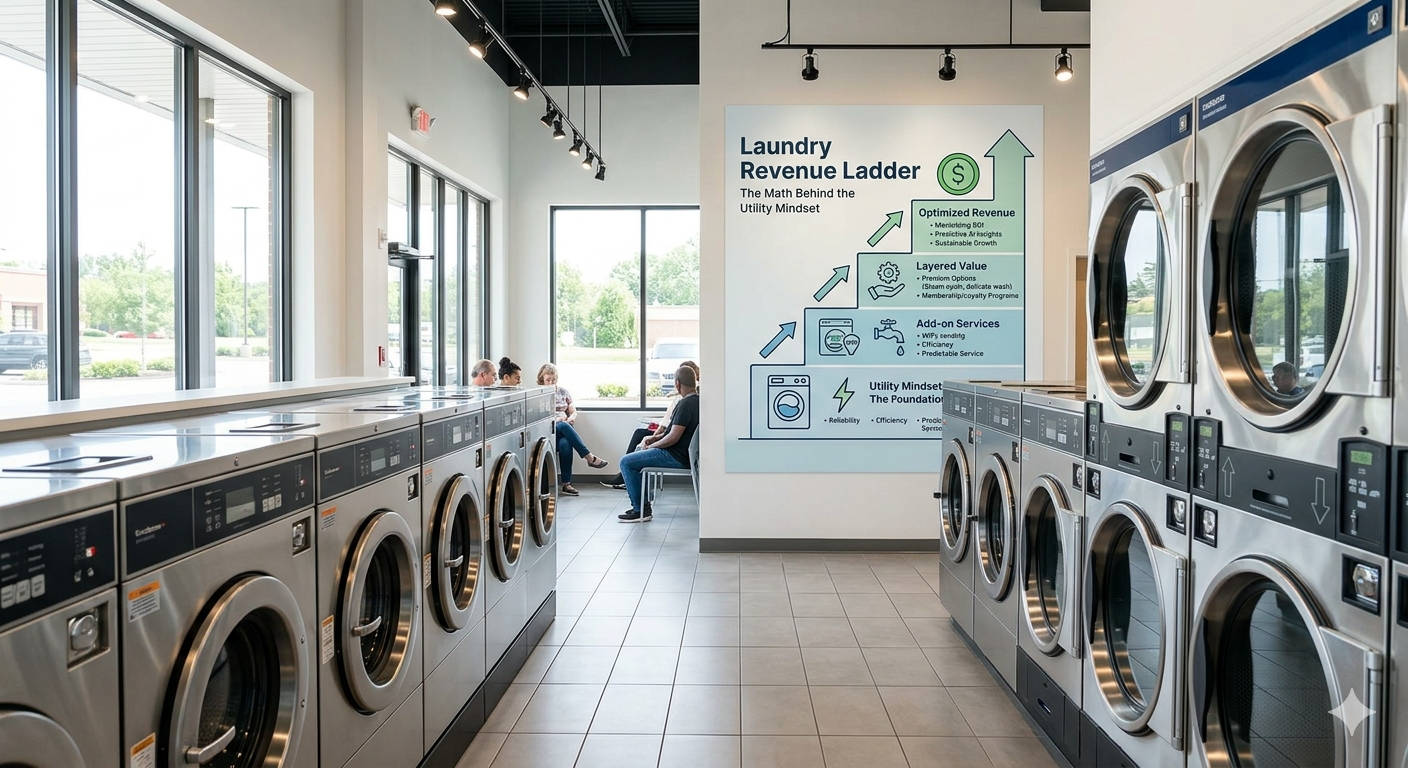
When you successfully engineer Machine Velocity and trigger the Labor Loop, you establish a clear, highly profitable Revenue Ladder for your facility. This ladder captures every demographic of customer by selling the ultimate commodity: time.
Entry: Self-Serve. At the bottom of the ladder is the traditional self-serve customer. Here, the customer does 100% of the physical work and sorting.
The Bridge: Wash/Dry/Go. This is the essential middle tier that drives long-term customer lifetime value. Here, the customer buys back 80% of their time at a highly affordable utility rate, and your facility maximizes machine throughput.
The Premium: Wash/Dry/Fold. At the top of the ladder is the premium tier. The customer pays a boutique fee to buy back 100% of their time, and your staff executes the meticulous, 45-minute premium fold.
By providing a bridge between manual self-serve and premium boutique folding, you capture a massive demographic of busy professionals and families who value their time but refuse to pay luxury prices for basic chores.
You cannot scale your operation relying on manual grit, and you cannot maximize your revenue if your staff is chained to a folding table while machines sit idle. By implementing Categorized Stacking, strictly enforcing minimums, and relying on active labor to drive passive sales, you architect a financial machine that scales infinitely.
Moving from Reactive to Precision.
Stop putting out fires and start building your architecture. Stay precise.
— Nicholas J. Gomez, Co-Owner, Super Kleen Laundry & Founder, AIforlaundromats.org